
7 REASONS SMALL GROUP TOURS IN HAWAII OFFER BETTER TRAVEL EXPERIENCES
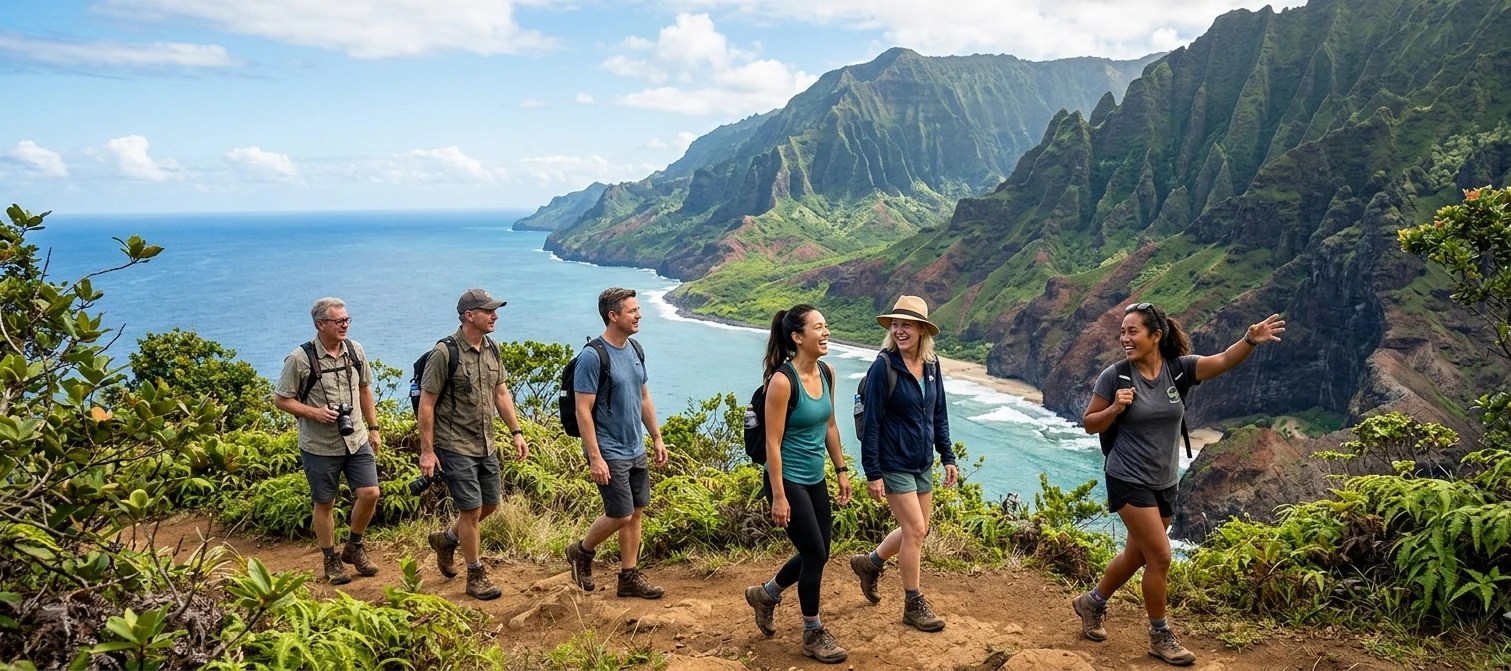
The tour bus seats forty-eight. You’re somewhere in row sixteen. The guide’s voice fights through a microphone someone keeps adjusting, and the only volcano you’ve seen for the past twenty minutes is the one printed on the brochure tucked in the seat-back pocket. That’s the part of a Hawaii vacation nobody photographs, and the part most travelers don’t realize they signed up for until they’re already on the road.
There’s a better way to experience these islands, and most travelers find it the same way: by accident, on their second trip. Smaller groups, real local guides, and itineraries that breathe instead of sprint. Here are seven reasons that approach earns its reputation, regardless of which island you choose first.
What Small Group Tours Mean in Hawaii
Two things set small-group travel apart from a standard coach tour. Group size and guide access decide how the whole day actually feels; let’s explore those two variables.
Smaller Group Size
Hawaii small-group tours typically cap at 12 guests per vehicle, and Malama Tours keeps its departures tighter than that. The difference becomes evident when you pull up to a busy visitor attraction. A small group walks in together, finds the meeting point, and moves on without the long shuffle and constant headcount that defines larger groups.
Local Guide Access
A local guide does more than narrate. Our guides grew up on these islands, drove these roads in high school, and know which lookouts capture the best light at what hour. That working knowledge reshapes the tour itinerary in ways no recorded commentary can match.
Reason 1: More Personal Guidance From Local Experts
A guide’s knowledge only reaches you if they can actually talk to you. On a coach carrying fifty passengers, most of what the guide knows never crosses the third row. On Hawaii small group tours, your guide can pause the van, answer follow-up questions, and tell the story behind the story.
Our guides bring a real local perspective to every stop, from the volcanic geology of a crater rim to the WWII history behind the USS Arizona Memorial at Pearl Harbor and what December 7, 1941, actually meant for the people who woke up to it on Oahu.
That depth carries across all the islands. Spend time in Kailua Kona on the Big Island, climb above the clouds at Haleakala National Park on a Maui day trip, or hike a quiet stretch of Oahu’s North Shore, and a knowledgeable guide turns each stop into a story you remember years later.
Reason 2: Easier Planning and Fewer Travel Decisions
Planning a Hawaii vacation produces an unreasonable number of decisions. How many islands fit into your time? Which order works best? When do you book their flights, and should you take inter-island flights in the morning to avoid trade-wind delays? Which days bring excellent weather to which coast? For first-time visitors, the research devours weeks of evenings before you start packing.
A small-group tour eliminates most of that work. Your tour itinerary arrives pre-built and already includes transportation, stops, timing, and the local context that takes guidebooks fifty pages to explain. You skip the parking headaches, the wrong-turn detours, and the guesswork about which visitor attractions close their access roads during the rainy season.
What you get on any trip is that rare resource: attention. You step out of the vehicle ready to look at what’s actually in front of you, not on your phone.
Reason 3: More Flexible Pacing Than Large Group Tours
Large group tours run on a stopwatch. When forty or more people need to load, unload, and reassemble at every stop, even minor transitions eat directly into your beach time.
Efficient Transitions
A van of eight pulls out of the parking lot in two minutes, A coach of fifty takes fifteen. Across six or seven stops in a day, that math swings hard toward the smaller group. And the reclaimed minutes flow back into time at the next destination.
Better Stop Timing
Small group tours in Hawaii let guides read the energy in the vehicle and respond to it. Sea turtles at the snorkel spot? Stay another half hour. Clouds roll in over the lookout? Move on. That kind of real-time call does not survive contact with a forty-person itinerary on a tight clock.
Reason 4: Better Access to Hawaii Adventure Experiences
Hawaii’s best moments tend to happen off the road. Pristine beaches that the rental-car never finds, snorkel breaks above living coral reefs at high tide, and the trailheads tucked behind unmarked turnouts. Reaching any of them takes a guide who knows where they are and a group small enough to fit without stripping the place of what makes it sublime.
Big coaches simply cannot access many of these locations. Narrow shoulder lanes, parking caps, and entry rules at select tours and nature reserves close the door on larger groups in ways small ones slip right through.
With Malama Tours, you reach places that never appear on a standard bus itinerary. Catching excellent weather on the leeward side while the windward coast sits under cloud, spotting humpback whales offshore from a quiet bluff in winter, or hitting a national park trail before the first coach clears its parking lot: small-group moments, every one of them.
Reason 5: Stronger Safety Support During Activities
Safety on adventure activities relies on the guide-to-guest ratio. With eight guests instead of forty, your guide actually tracks every person, identifies a problem before it happens, and adjusts the moment conditions change on the water or the trail.
Malama Tours bases its activities on small-group safety standards. ATV rides at Coral Crater Adventure Park cap at 3 vehicles per guide, keeping the guide’s eyes on every rider throughout the entire route. The same principle drives water-based tours, where ocean conditions can change in twenty minutes, and individual attention does the heavy lifting.
For first-time visitors trying something they’ve never done, that ratio changes the experience. A guide with a small group has time to walk through the technique, check that the equipment fits, and read hesitation in someone’s body language before it becomes a real problem. That attention lets you settle into the activity rather than bracing against everything you don’t know yet.
Reason 6: More Respectful and Mindful Travel
Hawaii is not a backdrop. The reefs, the trails, and the communities you walk through carry the weight of every visitor, and group size decides how much of that weight actually impacts this beautiful place.
Respect for Place
Small group travel leaves a smaller mark on sensitive locations. Coral reefs, coastal trails, and national park sites all have real limits, and smaller groups leave those places closer to how they found them. Hawaiian culture treats caring for the land as a baseline responsibility, not a bonus extra, and that mindset determines how a thoughtful operator builds the day.
Community Awareness
Malama Tours takes this aspect of the job seriously. The name itself comes from the Hawaiian word ‘Malama,’ which means to care for. That practice is apparent in active beach cleanups, sustainable tourism choices, and conservation work across Oahu. Travelers who visit Hawaii in smaller groups also spend more time in local businesses and leave a noticeably lighter footprint.
Reason 7: More Memorable Connections With Fellow Travelers
Travel works better with the right people by your side. On a fifty-person coach, the group size alone keeps everyone polite and at arm’s length, and the format doesn’t invite anyone to lean over and start a real conversation.
Smaller groups change the math entirely. Eight to twelve people sharing a full day across the Valley Isle (Maui), standing together at a memorial, or watching humpback whales surface from the same vantage point, build the kind of easy familiarity you simply cannot manufacture.
Those connections often last past the day itself. Plenty of travelers who book small-group tours in Hawaii finish the day with new friends, a list of recommendations swapped for the rest of their vacation, and a solo itinerary that becomes a shared one between the first stop and the last.
Frequently Asked Questions
Are small group tours in Hawaii worth it?
For anyone who wants more than a windshield-tour version of the islands, yes. Small-group tours give you more guide time, greater flexibility at each stop, and access to places larger groups cannot reach. Most travelers who try this format on their Hawaii tours never go back to the coach-bus model.
Are small group tours better than large bus tours?
Yes, on every variable that matters to your day. Your guide can respond to the group, change the pace, and share the kind of local knowledge that gets lost in a fifty-person broadcast. The experience is more profound, and the day’s rhythm matches how most people actually want to travel.
How many people are usually in a small group tour in Hawaii?
Most operators cap their groups between eight and sixteen guests. Malama Tours intentionally keeps its departures small to preserve the quality of each experience. The exact count varies with the activity, but the rule holds steady: every guest receives attention at every stop, not just a wave from the front of the van.
What should I bring on a small-group tour to Oahu?
Sunscreen, a hat, comfortable walking shoes, a water bottle, and a light layer cover most days. If your tour includes water activities, pack a change of clothes. Check your itinerary for activity-specific gear, and your guide will brief you on anything else in the morning.
Can small group tours be customized?
For a thoughtfully tailored day, Malama Tours runs private tours that let you set the route, pick the stops, and build the day around your group’s interests. Pre-designed departures follow a set itinerary, but guides routinely adjust the pace and linger for longer wherever the group’s genuine interest shows.